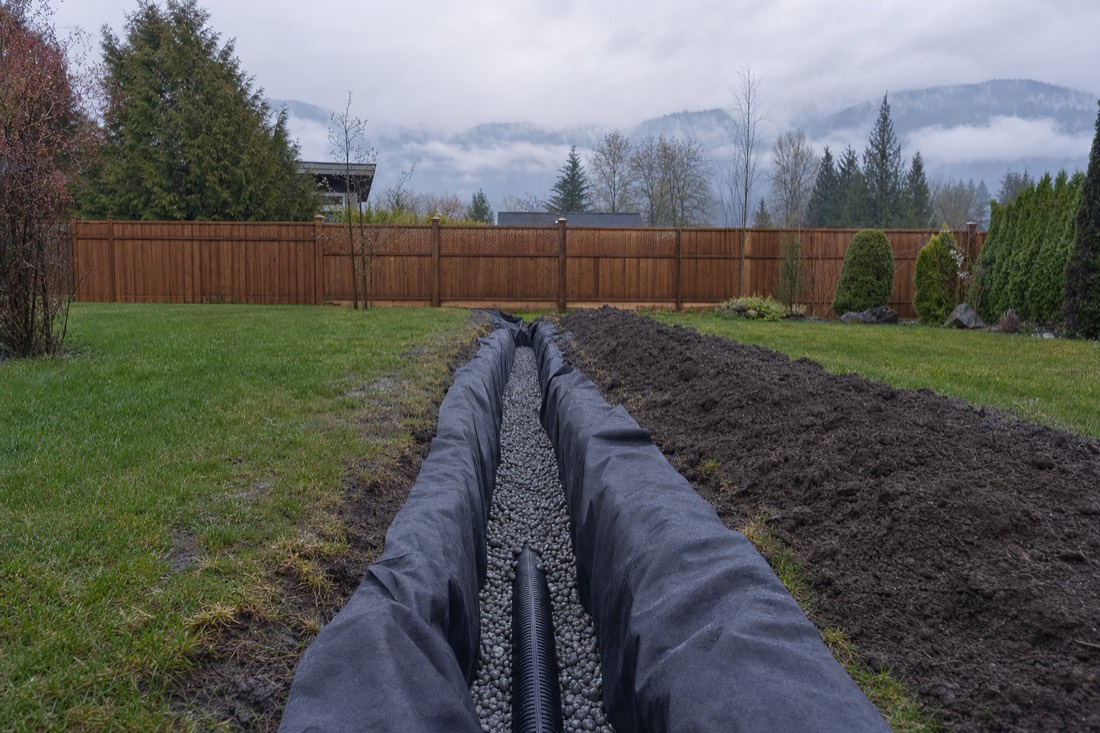
What Yard Drainage Does
Yard drainage gives surface water and shallow groundwater a faster path than the one nature provides. The workhorse is the French drain: a trench cut across the flow of water, filled with washed drain rock around a perforated pipe, wrapped entirely in filter fabric, and sloped to a discharge point. Water entering the trench drops into the rock, finds the pipe, and leaves your property in minutes instead of standing in your lawn for days.
Around it we use the rest of the toolkit as the site demands: catch basins where water ponds on hard surfaces, channel drains across driveways and patio thresholds, swales to steer sheet flow, solid pipe to carry collected water to the discharge, and dry wells where the municipal storm system is out of reach. The design question is always the same: where does the water come from, where does it gather, and where can it legitimately go.
The Fraser Valley Yard Problem
Two local facts make valley yards wet. First, the rain: much of the region receives over 1,500 millimetres a year, concentrated between October and February, with atmospheric river events dropping a month's worth in days. Second, the soil: large areas of the valley floor are fine silt and clay-rich soils that pass water slowly, so winter rain arrives far faster than the ground can absorb it. The result is the classic Fraser Valley lawn, green as Ireland and unwalkable from Halloween to Easter.
Hillside neighbourhoods add a third fact: gravity. Homes on the slopes of Mission, on Promontory and Ryder Lake in Chilliwack, and on Sumas Mountain and Eagle Mountain in Abbotsford receive their own rain plus the runoff of every property above them. When that concentrated flow reaches a flat backyard or a foundation, it makes trouble that grading alone cannot solve.
Common Projects We Build
- Interceptor drains for hillside runoff. A French drain across the uphill side of the property, catching descending water and routing it around the house. Often paired with a swale for surface flow. If the water currently reaches your foundation, this project also protects your perimeter drains from doing a job they were never sized for.
- Lawn and garden drains. Runs placed through the wet zones of a soggy lawn, lowering the saturation so grass roots can breathe and the surface firms up.
- Driveway and parking drainage. Channel drains and catch basins that stop ponding at the garage door and keep winter water from undermining paving.
- Downspout discharge runs. Roof water is the largest single water source on most lots. Piping downspouts to a proper discharge instead of a splash block removes thousands of litres per storm from the soil around your house.
- Retaining wall drainage. Walls without drainage behind them lean and fail. We install or retrofit the drain rock and pipe that let walls shed the water pushing on them.
How We Build Them to Last
- Walk the water. We assess the property, ideally during or after rain, and map sources, gathering points and the workable discharge. Design follows the water, not a template.
- Real slope, real depth. Pipe laid on consistent fall toward the discharge. A flat French drain is a buried bathtub.
- Washed rock and full fabric wrap. Filter fabric around the entire gravel envelope keeps valley silt out. Skipping it is why cheap French drains die in three years.
- Cleanouts. Access points so the system can be flushed and camera-checked in the future, the same maintenance logic we apply to perimeter drains.
- Legitimate discharge. Storm connection, dry well or approved surface outlet, selected to municipal rules, never a problem exported to the neighbour.
Yard Water Becomes House Water
A soggy yard is more than a nuisance, it is the staging area for a wet basement. Water standing in the lawn is water loading the soil that drains toward your footing, and a winter of saturated ground is exactly the condition that overwhelms aging perimeter drains and pushes moisture through foundation walls. We frequently find that the cheapest improvement to a damp basement is outside the drip line: intercept the hillside runoff, pipe the downspouts away, drain the low corner of the lawn, and the perimeter system stops fighting a losing battle. If your basement and your yard are both wet, start with a camera inspection and a site walk, and we will sequence the fixes from cheapest to most effective.
Frequently Asked Questions
How much does a French drain cost in the Fraser Valley?
Typical residential French drain projects run from around $2,000 for a short single-run drain to $10,000 or more for full-yard systems with catch basins and long discharge lines. The main cost drivers are trench length and depth, how the water will discharge, and what surfaces the trench crosses. We quote a firm price after walking the property, ideally while it is raining.
What is the difference between a French drain and a perimeter drain?
A perimeter drain runs at footing depth against the foundation and protects the basement. A French drain is a gravel trench with perforated pipe placed wherever water collects, along a fence line, across a slope, beside a driveway, to intercept and redirect surface and shallow groundwater. Same principle, different job. Many soggy-yard problems need one, not the other, and some properties need both.
Will a French drain fix my soggy lawn?
If the lawn is soggy because water arrives faster than the soil can pass it along, yes, an interceptor drain placed across the flow path collects that water and moves it to a discharge point, and the lawn firms up remarkably. If the sogginess is a high water table rising from below across the whole property, drains help but expectations should be honest, and we will tell you which situation you have before quoting.
Where does the collected water go?
Every French drain needs a legitimate destination: the municipal storm system where a connection is available, a properly built dry well or rock pit where soils allow, or a surface discharge point low enough and far enough away that the water cannot return. Sending it to the neighbour is not a plan, and municipalities have rules about storm connections that we handle as part of the job.
Can you drain water away from a hillside home?
Yes. Hillside properties in Mission, Promontory in Chilliwack, and the Abbotsford mountain slopes deal with uphill runoff arriving during every storm. An interceptor French drain across the uphill side, sometimes paired with a swale, catches that water before it reaches the house and moves it around and past. This is one of the most effective drainage projects a hillside homeowner can buy.
How long do French drains last?
A properly built French drain, with washed drain rock, filter fabric wrapping the entire gravel envelope, and perforated pipe on real slope, lasts for decades. The failures you hear about come from skipped fabric (the trench silts solid in a few years), unwashed rock, or pipe laid flat. Built right, maintenance is an occasional flush of the pipe from its cleanout.